
From innovative RAS systems to new skills: why training is the real driver of change
Aquaculture is increasingly becoming one of the strategic pillars of Europe’s food system. As demand for seafood continues to grow and wild fisheries face natural limits, fish farming is expected to play a larger role in ensuring both food security and sustainable protein production.
But the future of aquaculture will not be defined only by production volumes. The real challenge is different: how to produce better, using fewer resources and smarter systems.
Water use, energy efficiency, feed sustainability and waste management are now at the centre of the sector’s transformation. And this is exactly where the concept of circular aquaculture comes into play.
Projects such as CIRCU-TECH have been created precisely to support this transition. The European initiative focuses on strengthening professional competences in circular aquaculture through innovative training tools, including digital learning environments and immersive technologies like virtual and augmented reality.
The underlying idea is simple: the sector is evolving quickly, and the people working in aquaculture need the tools to evolve with it.
When circular thinking becomes real
While European projects work on training and knowledge transfer, technological innovation is already showing what circular aquaculture can look like in practice.
A particularly interesting example comes from Italy. The case is the NextFish Center, developed by the VRM Group at the NaturAlleva facility near Verona.
VRM is today one of the most dynamic players in the Italian aquaculture supply chain. Founded in 2006, the company has grown into an international group active in aquaculture nutrition, research and production systems. Its strategy has always been strongly oriented toward integration between feed innovation, research and fish farming.
The NextFish Center is perhaps the clearest expression of this vision.
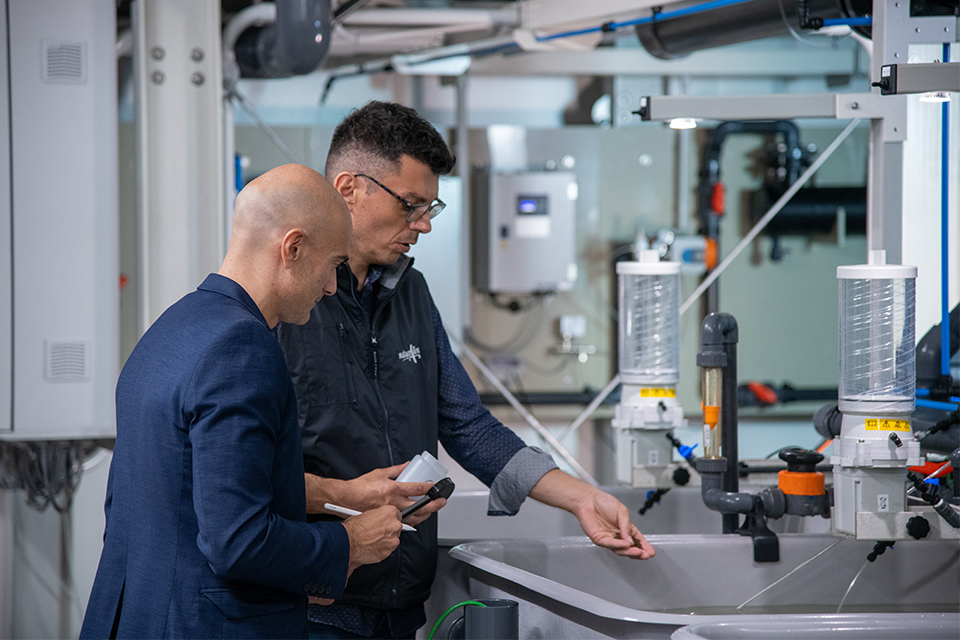
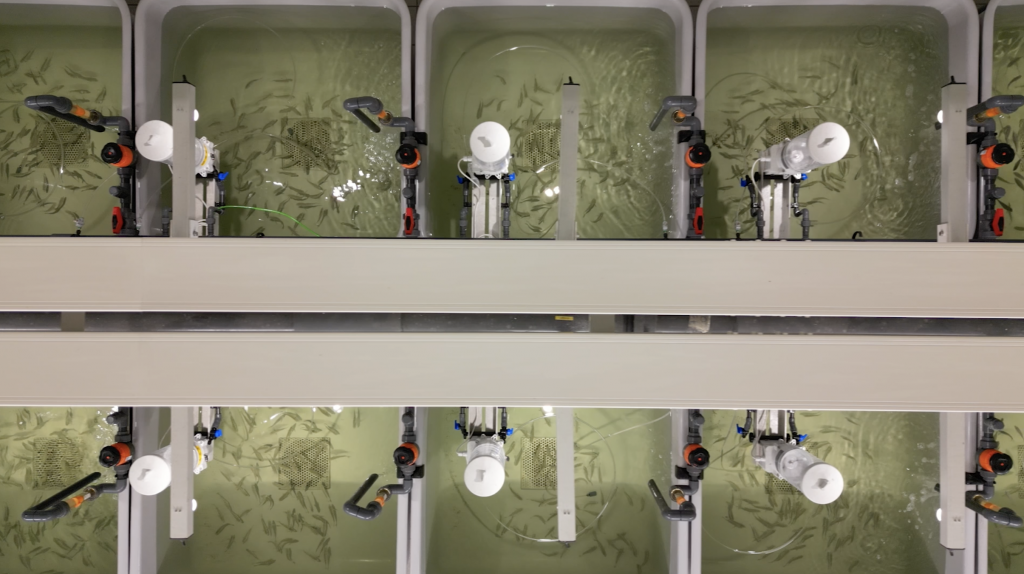
The facility is built around Recirculating Aquaculture Systems (RAS), a technology that allows fish to be farmed in highly controlled environments where water is continuously filtered and reused. Instead of relying on large water flows, RAS systems treat and recirculate the same water, drastically reducing consumption and environmental impact.
At the NextFish Center, advanced filtration technologies combined with real-time monitoring systems allow the facility to reuse up to 98% of the water used in the system. Sensors constantly track parameters such as oxygen levels, temperature, salinity and water quality, ensuring optimal conditions for fish growth while minimising resource use.
Yet what makes the project particularly interesting is not only the technology itself.
The centre was designed as a research platform where nutritionists, biologists and technicians can test new feed formulations, evaluate fish performance and study alternative ingredients before transferring the results to commercial aquaculture operations.
In other words, the facility acts as a bridge between research, feed development and real production systems.
This kind of integrated approach is exactly what the sector needs to move forward: innovation that does not remain confined to laboratories but can be applied directly to aquaculture farms.
Innovation is also a matter of skills
However, even the most advanced production systems cannot work without people who know how to manage them.
Modern aquaculture is becoming increasingly sophisticated. Operating RAS facilities, understanding environmental data, managing biological processes and optimising feed efficiency require a new generation of skilled professionals.
This is where the importance of training becomes clear.
The CIRCU-TECH project aims precisely to address this challenge. By developing innovative learning tools and immersive training environments, the project helps students, technicians and aquaculture operators better understand how circular production systems work.
Through digital simulations and interactive learning environments, complex processes—such as water recirculation, waste management or system optimisation—can be explored in ways that traditional training methods often struggle to achieve.
The future of aquaculture depends on knowledge
The example of the NextFish Center shows that circular and highly efficient aquaculture systems are no longer theoretical concepts. They are already operating today, proving that it is possible to combine productivity, environmental responsibility and technological innovation.
But scaling these solutions across the sector will require more than investment in infrastructure.
It will require people who understand the systems, know how to manage them and are capable of continuously improving them.
This is why initiatives like CIRCU-TECH are so important. They ensure that innovation does not stop at technology, but extends to the skills and knowledge of the people working in the sector.
Because in the end, while technology can transform aquaculture, it is education and training that truly determine how far the sector can go.