
Mussel farming is one of the most established sectors of European aquaculture. In 2023 the EU produced more than 360,000 tonnes of farmed mussels, about a fifth of global output, and Spain, France and Italy together accounted for 73% of it [1]. Italy is the third-largest producer in EU, with most of its farms located along the Adriatic coast.
Mussel farming combines a low environmental footprint with several ecological benefits. Like oysters and clams, mussels are filter feeders, they feed on phytoplankton and organic particles directly from the water column, thus they are not externally fed. In doing so, they incorporate nitrogen and phosphorus into their tissues and shells, and these nutrients are removed from the sea. Mussel farms can therefore help to contrast eutrophication and buffer the excess of nutrients in coastal waters. Their carbon footprint is also among the lowest of any aquatic food [2].
However, despite these environmental benefits, mussel farming also faces a significant sustainability challenge: the use and management of plastic farming equipment. Mussel farmers rely on large quantities of plastic socks, the tubular nets in which the mussels grow, and part of this gear is lost at sea, either during routine operations or in extreme weather events. EU law has recognised the problem since 2019 with the Directive (EU) 2019/904, known as the Single-Use Plastics Directive. The Directive defines fishing gear as any equipment used in fishing or aquaculture to catch or rear marine organisms, and requires Member States to set up extended producer responsibility (EPR) schemes for gear containing plastic. Mussel socks fall within this scope.
What is a mussel sock?
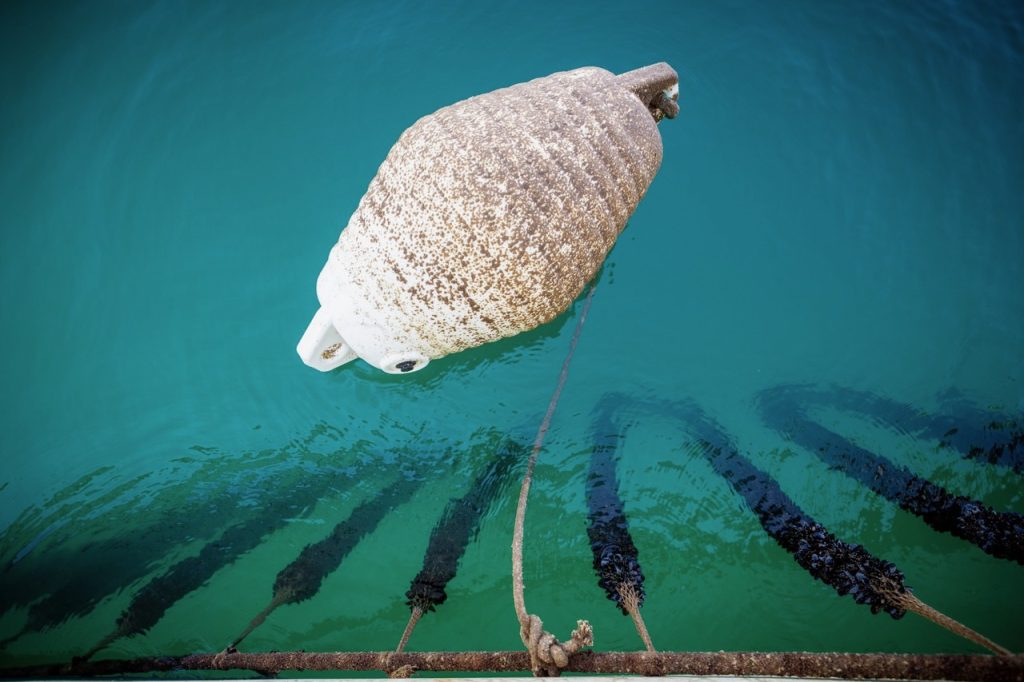
Longline system, a common offshore system to farm mussels in Europe, is composed by horizontal ropes held near the surface by floats (Figure 1). From these hang tubular plastic socks (mussel nets) packed with mussels, which attach to the mesh and grow until they reach market size.
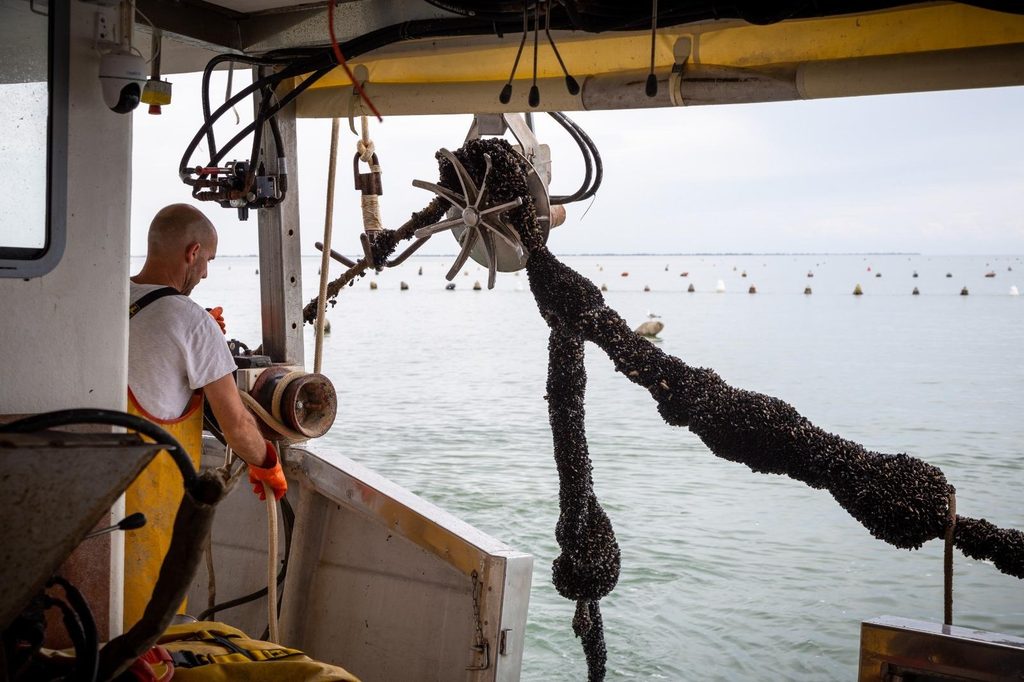
Maintenance of mussel socks at an offshore longline farm
(Photo credit: Juan Martín Baigorria).
Such socks are mostly made by polypropylene, with a length on between 3 and 5 m (Figure 2). According to recent surveys across Italian mussel farmers, on average every farm use 1,300 kg of socks every year [3].
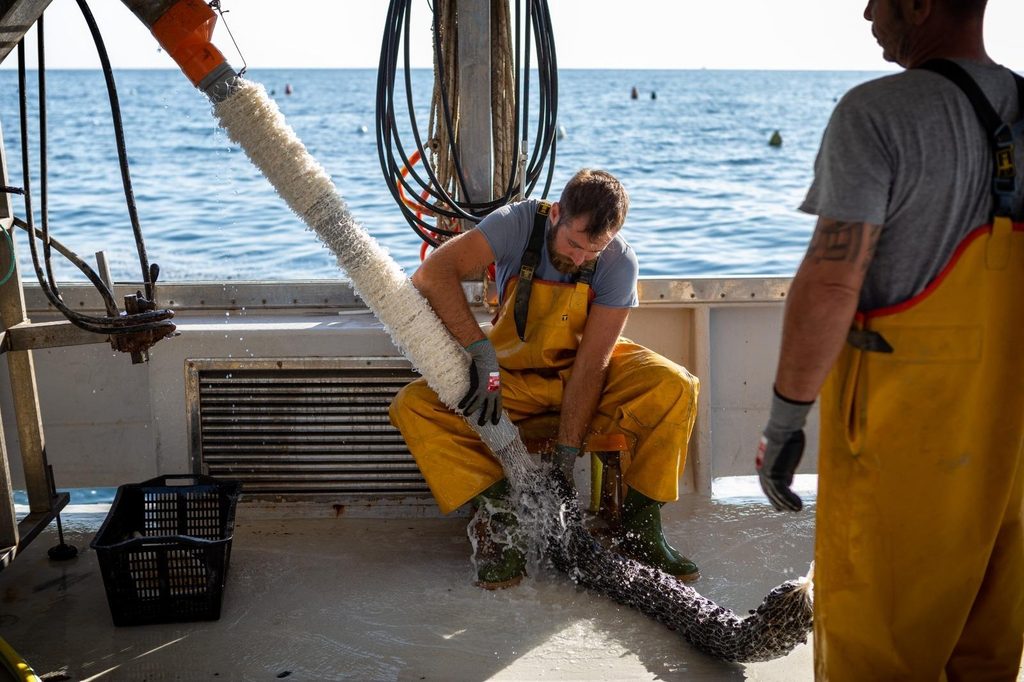
Routine operations aboard a vessel in a offshore longline farm
(Photo credit: Juan Martín Baigorria).
During the production cycle, mussels are re-socked several times. Each re-socking produces used socks that must be handled on board and brought ashore. This is where the problem starts.
From shellfish farm to seafloor
But how do socks end up at sea and become marine litter? Socks are lost mainly during handling and routine operations on board, but storms can also have a profound impact, increasing plastic pollution at sea. For example, a storm surge in November 2017 is estimated to have caused the loss, or the emptying, of more than 50,000 socks in several offshore farms off the Po River Delta (Italy) [4].
There is one more crucial detail. Plastic nets recovered from the seabed are often difficult to recycle because they may be heavily colonised by marine organisms and contaminated with sediments, making cleaning and processing more challenging. Once a sock reaches the seabed, its value as a raw material is largely lost. Circularity, therefore, has to start at the quay.
Building a circular supply chain
An interesting case study of circularity in this sector comes from the Life Muscles project, which ended in 2025 [5]. Its core idea was to treat used socks as a resource rather than as special waste, a principle fully aligned with the concept of circularity. One of the main tools developed under this project was a mobile recycling plant, mounted in a shipping container, that can process up to 300 kg of socks per day close to where they are used. The project also organised seminars for mussel farmers and fishers in several Italian locations, to increase stakeholder engagement and training opportunities. Indeed, technology and innovation cannot have an impact if they are not supported by a proper training offer, capable of providing operators with the right knowledge and skills and enabling them to adopt it.
Recycling a mussel sock is not trivial, because used nets carry byssus threads, shell fragments and sediment. Trials led to a simple sequence that starts with rinsing at sea, followed by drying on land, mechanical grinding of the nets, washing with water and, finally, re-extruding the clean polypropylene into new socks. This translated into operational guidelines for shellfish farmers.
Interestingly, the mechanical and chemical analysis on the recycled socks found that the properties are comparable to those of virgin polymer.
Case study: a circular solution that reaches the market
Rom Plastica srl, a partner of the Life Muscles project, is an Italian company based in Chioggia (Venice) and one of leading manufacturers of plastic nets for mussel farming in Italy. Within such project it designed the mobile recycling plant, and it now produces socks in recycled polypropylene.
What makes the case interesting is that the producer takes back its own material. Farmers deliver their used socks, and the company turns them into new ones. This resembles EPR, the principle that producers take charge of the end of life of their products, which EU law now requires Member States to introduce for plastic fishing and aquaculture gear. Here, however, the model is built from the bottom up rather than imposed from above.
The figures that are emerging are encouraging in terms of savings and disposal costs. According to Rom Plastica, farmers can save between 33% and 40% on the purchase of new socks, including recycling costs such as labour and electricity. They also avoid disposal costs, which for farms that pay for them are about €0.20 to €0.30 per kilogram of used socks. For an average farm, which spends about €5,200 a year on socks, this would mean savings of roughly €1,700 to €2,100 a year, plus the avoided disposal costs.
The company also plans to continue the activity after the end of the project. It aims to reach the market, partly by transferring the model to other countries, and to bring the technology to a higher Technology Readiness Level (TRL), a scale from 1 to 9 describing how mature a technology is.
Training as a strategic approach for circular innovation in aquaculture
The cited experience and case studies show that technology is only one link of the circular economy. Recycled socks exist because each actor plays its part, starting from farmers, who rinse, dry and deliver the socks to ports providing dedicated collection points, ending with producers, who re-use the polymer. If the right skills are lacking and stakeholder engagement is scarce, the risk of socks ending up on the seabed is high.
This is why training matters. It is the lever that turns a pilot project into everyday practice, and innovation into a standard for the whole sector.
CIRCU-TECH works precisely on the links between innovation, technology and skills. By developing structured training also on circular waste management in aquaculture, the project helps operators, technicians and students turn solutions into practice across Europe.
Mussel farmers, port authorities, gear producers and training providers all have a role to play. The mussel sock is a small object and a clear example that shows how circular aquaculture starts with people who know what to do with it.
Reference list:
- EUMOFA. Mussels: species profile. European Market Observatory for Fisheries and Aquaculture Products.
- Gephart, J.A., Henriksson, P.J.G., Parker, R.W.R. et al. Environmental performance of blue foods. Nature 597, 360–365 (2021).
- LIFE MUSCLES. (2022). Report B.1.1/B.1.2. Le caratteristiche della calza standard e le linee guida operative di utilizzo per la mitilicoltura [Characteristics of the standard sock and operational guidelines for use in mussel farming].
- Mistri, M., & Munari, C. (2019). Effects of a storm surge on mussel off-shore farming in the Po Delta, northern Adriatic Sea. Journal of Aquaculture & Marine Biology, 8(5), 151–152.
- LIFE MUSCLES. (n.d.). LIFE MUSCLES, MUssel Sustainable production (re)cyCLES – lifemuscles.eu